

League of Legends Outage Breakdown: Riot Certificate Error Explained
League of Legends outage disrupts play worldwide
The League of Legends outage early in January 2026 left players around the globe unable to launch or log into one of the world’s most popular games. Instead of a server crash or cyberattack, the outage stemmed from a surprisingly simple but critical technical error: an expired security certificate embedded in the game client. This mishap highlighted how even small oversights in infrastructure management can impact millions of users.
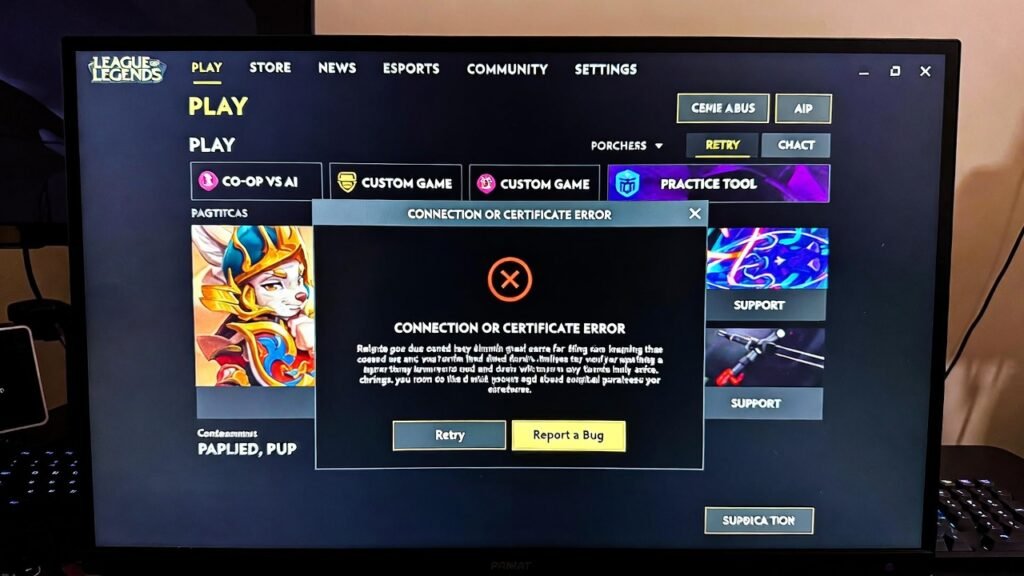
What caused the League of Legends outage?
At the heart of the disruption was an SSL (Secure Sockets Layer) certificate designed to secure encrypted communication between the League of Legends client and Riot’s servers. SSL certificates act like digital ID cards that verify safe connections over the internet.
In this case, the client’s built-in certificate had expired, preventing the game from establishing a secure connection with Riot’s servers. Modern systems began rejecting any attempt by the client to establish a secure connection because it was no longer considered trustworthy. As a result, players worldwide saw connection errors, frozen launch screens, and failed logins. Ranked play queues were temporarily disabled as Riot scrambled to resolve the issue.
A technical history repeating itself
What made the incident especially notable is that a nearly identical issue occurred a decade earlier. Riot Games faced the same expired certificate problem in early 2016, when a similar SSL lapse prevented players from logging in.
For players and observers, two major outages caused by the same root problem, ten years apart, reinforced a perception that even large gaming companies can struggle with routine maintenance tasks if systems aren’t automated or thoroughly tracked.
How players experienced the outage
The outage didn’t just prevent logins it affected gameplay for many users trying to join ranked matches, chat with friends, or play normally scheduled games. Reports of errors spiked, with complaints indicating thousands of players were affected within minutes of the certificate’s expiration.
Some players described seeing generic connection errors or clients that stalled indefinitely at the loading screen. Others found their Riot Games client couldn’t launch games or even reach login servers. This widespread disruption added urgency to the discussion of how modern online services manage critical infrastructure components.
Temporary workarounds and community ingenuity
As reports of the issue spread, tech‑savvy players quickly uncovered a quirky temporary workaround: manually setting their computer’s system clock back to a date before the certificate’s expiration. Because the client would then see a still‑valid certificate, it would allow login and gameplay.
While this fix sometimes worked, it came with risks. Changing system time can cause conflicts with other software, security features, or network functions that depend on accurate timestamps, and it was not an official recommendation from Riot.
Riot’s response and the fix
Once the expired certificate was confirmed as the issue, Riot Games acted to resolve the outage. Engineers prepared and deployed an updated client certificate, extending its expiration far into the future reportedly up to the year 2125 to prevent the same problem from recurring.
During the outage, Riot temporarily disabled ranked queues so that competitive play wouldn’t unfairly impact player rankings while the service was disrupted. Gradually, as the certificate was renewed and clients updated, access to League of Legends was restored across major regions.
Broader lessons from the outage
While the outage itself was resolved within hours, its implications extend beyond a single technical error. Online games like League of Legends depend on multiple layers of security, networking, and authentication. Each of these layers must be maintained and monitored rigorously to avoid breakdowns that impact millions of users.
The 2026 outage also sparked community discussion about legacy systems and how long‑running software must adapt to changing security standards and infrastructure expectations. Though an expired certificate might sound mundane, it underlined the fragility of complex live-service ecosystems.
Why infrastructure details matter
Security certificates, while technical, are an essential part of modern connected applications. They ensure the integrity and privacy of data as it travels between clients and servers. When a certificate expires unexpectedly, systems can treat the connection as unsafe leading to automatic rejection and failures.
For gaming companies and online services, maintaining a careful schedule of renewals, automated reminders, and cross‑team communication can prevent similar issues. Simple administrative oversights can otherwise undo years of reliable uptime and player trust.
Technical and Community Impact of the League of Legends Outage
The League of Legends outage also highlights the complexity of modern game infrastructure. Online games like LoL are not just software running on a single server; they are vast ecosystems that depend on a combination of client software, server networks, authentication protocols, and security certificates. Each layer must operate seamlessly to provide players with uninterrupted access. When the SSL certificate expired, the client could no longer verify the identity of Riot’s servers, effectively halting millions of connections. This small technical detail cascaded into a global outage, demonstrating how critical proper maintenance and monitoring are in large-scale gaming operations.
Players expressed frustration, disbelief, and humor across social media platforms during the outage. Many joked about the absurdity of a simple certificate causing the game to be completely unplayable, while others discussed workarounds and potential improvements to Riot’s system. Streamers and content creators were also affected, as the downtime interrupted live broadcasts and community events. For competitive esports teams, the outage forced last-minute adjustments to practice schedules, highlighting how technical errors can ripple through both casual and professional gaming communities.
From an industry perspective, the incident underscores the importance of proactive infrastructure management. Automated alerts for certificate expiration, redundant security verification systems, and better internal communication protocols could prevent similar occurrences. Riot’s decision to extend the new certificate’s expiration until 2125 shows a commitment to eliminating this risk long-term, but it also emphasizes the need for ongoing vigilance in software maintenance.
The outage also sparked conversations about digital trust and accountability. Players depend on developers not only for gameplay experience but also for secure, reliable access to game services. Even brief interruptions can impact user confidence, retention, and engagement, especially in a globally popular title like League of Legends. By analyzing and learning from such incidents, gaming companies can strengthen both their technical resilience and community relations.
Helpful Resources
- Riot Games official service status page – see live and historical status of League of Legends and other Riot titles: https://status.riotgames.com/
- Downdetector League of Legends outage reports – community-sourced outage tracking showing spikes in reports: https://downdetector.in/status/league-of-legends/
- SSL certificate explanation (secure connection basics) – overview of what SSL/TLS certificates are and why they matter: https://www.cloudflare.com/learning/ssl/what-is-an-ssl-certificate/
Conclusion
The League of Legends outage in January 2026 served as a dramatic reminder that even widely played and technically sophisticated services are vulnerable to fundamental maintenance oversights. An expired security certificate something often handled quietly in the background brought one of the world’s biggest games offline for hours. As online gaming continues to grow and evolve, rigorous infrastructure practices and forward‑looking planning will be essential to avoid these kinds of disruptions in the future.
Explore These Stories
- Switch 2 Sales Performance – related coverage on gaming sales trends
- Xbox Game Pass Premium New Games – explore the latest additions to Game Pass
What to Read Next





One Comment