ASML Stock Moves and Infineon Strength Amid AI Boom
ASML Stock Performance Amid Record Results and AI Demand
The ASML stock performance recently caught attention as the shares turned negative despite strong quarterly results and a major AI‑driven surge in business activity. At the same time, other semiconductor companies like Infineon also showed resilience, highlighting how investor sentiment is navigating growth expectations and market realities in the chip industry.
In this article, we’ll break down what’s driving ASML’s share price movements, how its financials actually performed, and why Infineon’s strength matters for European tech investors.
Strong Revenue Growth but Mixed Market Reaction
AI‑Fueled Business Expansion
ASML, the Dutch maker of advanced lithography machines used to manufacture cutting‑edge semiconductors, reported a notable revenue increase in the final quarter of 2025. The company lifted its sales from around 7.5 billion euros in the previous quarter to approximately 9.7 billion euros, exceeding many analysts’ expectations and improving gross margins slightly. The robust demand is largely tied to the ongoing boom in artificial intelligence, which requires high‑precision chips and equipment.
Moreover, new orders for ASML’s technology remained exceptionally strong, with incoming business nearly doubling forecasts a clear sign that chip makers are investing heavily to expand production capacity.
Buyback and 2026 Outlook
In addition to strong quarterly growth, ASML announced a share buyback program valued at up to 12 billion euros through 2028. Buybacks can help support the stock price by reducing the number of shares on the market and returning capital to investors, which is often taken as a sign of confidence from corporate management.
For the year 2026, the company also projected further sales expansion, targeting total revenues of between 34 billion and 39 billion euros numbers that reflect continued confidence in long‑term industry demand.
Why Did ASML Stock Turn Negative?
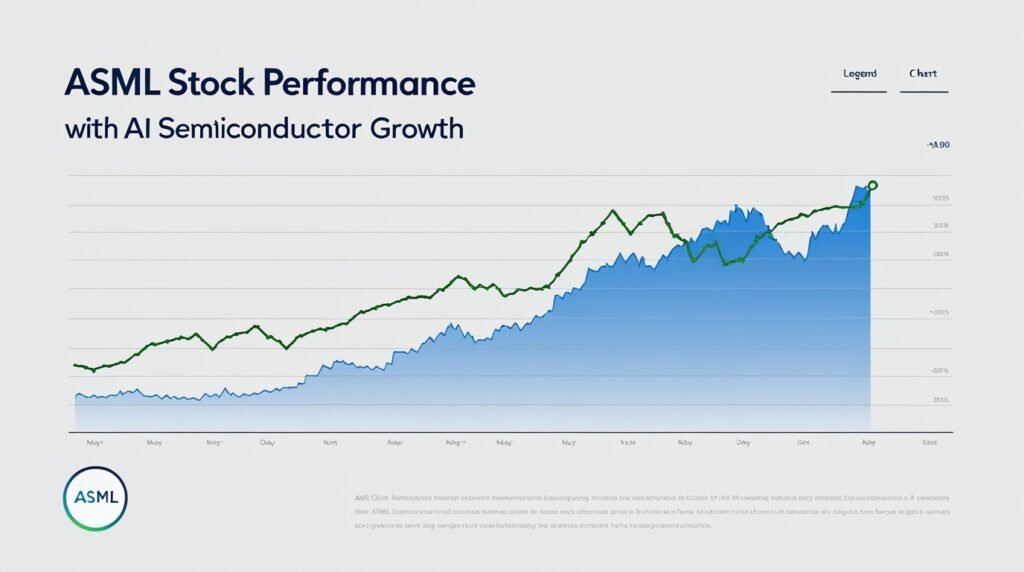
Despite these strong operational results, the ASML stock performance took a tumble in afternoon trading following the earnings announcement. After hitting record levels, the shares dipped and closed lower, even though they remain significantly above where they began the year.
Profit‑Taking and Market Expectations
Two key factors help explain this phenomenon:
- Exuberant Recent Rally: ASML shares had already climbed rapidly before the earnings release, nearly doubling in value over several months. When a stock rises steeply, investors sometimes take profits once strong results are reported, leading to short‑term selling pressure.
- High Expectations Priced In: While the results were good, they were perhaps already priced into the stock due to optimistic long‑term forecasts. With much of the positive news already reflected in the share price, traders may have reacted to any nuanced signals or cautious commentary by reducing exposure.
This kind of dynamic is common in markets where investor expectations are elevated: strong data doesn’t always translate into share price gains if the outcome isn’t significantly better than already anticipated.
Infineon’s Strength Amid Industry Momentum
While ASML was experiencing a mixed share reaction, Infineon another major European semiconductor company showed notable strength. Infineon’s stock broke through key levels and gained substantial ground early in the year, supported by broad tech sector enthusiasm.
Infineon’s performance suggests that investor confidence isn’t limited to a single company. Instead, it highlights broader optimism about the semiconductor industry’s growth, particularly from paths linked to artificial intelligence, electrification, and connected technologies.
This sector‑wide sentiment supports the view that demand for chips and semiconductors remains resilient, even as individual share prices adjust to new data.
Broader Tech Market and AI Impact
The semiconductor market is currently shaped by a multi‑year investment cycle, where chip makers and their suppliers are expanding capacity to meet accelerating demand from AI infrastructure, computing, data centers, and next‑generation devices. This cycle is underpinned by both logic and memory chip demand, with significant capital being allocated to future technologies.
At the same time, some stocks have seen broader rotation patterns in the market, where investors move funds between high‑growth tech names and other sectors based on expectations for profitability, valuation, and macroeconomic conditions.
What This Means for Investors
Evaluating ASML Stock Performance
For long‑term investors, the near‑term dip in the ASML stock performance doesn’t necessarily signal underlying weakness. Rather, it reflects the nature of markets where pricing, expectations, and sentiment can shift quickly in response to financial data and future forecasts.
Investors looking at ASML should keep in mind:
- The company’s core business remains strong with record orders.
- Revenue and margins continue to trend upward.
- Strategic capital returns like buybacks add to shareholder value.
At the same time, it’s important to recognize that markets can be volatile when valuations are high, and even strong earnings won’t always lead to uninterrupted share price gains.
Helpful Resources
Understanding the Semiconductor Industry – Learn more about semiconductor industry trends and how global markets are evolving.
Artificial Intelligence and Chip Demand – Explore the impact of AI-driven chip demand on stock performance and technology growth.
Investing in Technology Stocks – A guide to investing in tech stocks for long-term growth.
Conclusion
The recent ASML stock performance illustrates a compelling but complex picture: robust quarterly results and future growth projections driven by the AI boom were met with profit‑taking and valuation adjustments in the market. Meanwhile, Infineon’s gains point to broader confidence in the semiconductor sector as a whole.
For investors, this underscores the importance of analyzing both company fundamentals and market psychology. Strong business performance doesn’t always translate into immediate share price growth but it does provide a solid foundation for long‑term value in a tech landscape shaped by AI and digital transformation.
What to Read Next