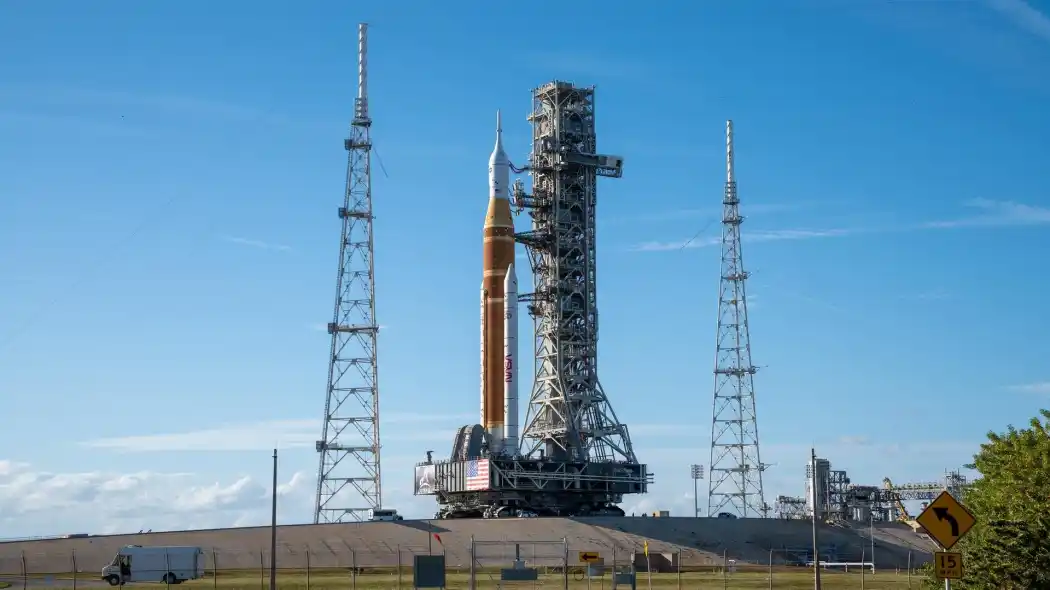
Artemis Moon Rocket Ready for Launch: What This Means for Lunar Exploration
Artemis Moon Rocket: Poised for the Next Giant Leap in Space Exploration
The Artemis Moon rocket is now positioned on the launch pad, marking a significant milestone in humanity’s return to lunar exploration. This massive Space Launch System (SLS) vehicle, built and operated by NASA, is at the heart of the Artemis II mission the first crewed flight around the Moon since the Apollo era.

In this blog post, we’ll explore what readiness means for Artemis, the crucial tests that still lie ahead, and why this launch matters not just for lunar science but for the future of deep space exploration.
What Is the Artemis Moon Rocket?
The Artemis Moon rocket refers specifically to NASA’s Space Launch System (SLS), one of the most powerful rockets ever built. This launch vehicle is designed to send astronauts aboard the Orion spacecraft beyond low Earth orbit and toward the Moon.
The SLS consists of:
- A core stage with four RS‑25 engines powered by cryogenic liquid propellants.
- Two massive solid rocket boosters that provide the majority of thrust at liftoff.
- The interim cryogenic propulsion stage (ICPS) that will help send Orion out of Earth orbit toward lunar distances.
Together, these elements create a rocket capable of achieving the velocity necessary to send humans farther into space than ever before.
A Historic Moment: Rollout to the Launch Pad
In January 2026, NASA teams completed the transport of the Artemis Moon rocket from its assembly point inside the Vehicle Assembly Building (VAB) to Launch Pad 39B at the Kennedy Space Center in Florida. This slow but steady rollout, conducted at roughly 1.3 km per hour, is more than symbolic it signifies readiness for final prelaunch operations.
Launch pads 39A and 39B are historic in their own right, originally used for the Apollo Moon missions, underscoring the legacy this program continues.
What Happens Now? Critical Tests Before Liftoff
Although the rocket is on the pad, the Artemis Moon rocket still must pass several major tests before liftoff can occur. The central one is the Wet Dress Rehearsal (WDR).
Wet Dress Rehearsal (WDR)
During the WDR:
- The rocket is fully fueled just like a real launch.
- Systems are tested through a simulated countdown.
- All procedures run up to about 31 seconds before liftoff are performed without a crew aboard.
Only a successful WDR can clear Artemis II for launch.
Launch Window and Timing
The earliest possible launch date for Artemis II is early February 2026, as long as no significant issues arise during testing.
NASA will use specific launch windows based on the relative positions of Earth and the Moon. If the February opportunity is missed, teams will wait for the next windows in March or April 2026.
Why Artemis II Matters
Returning Humans to the Moon
Artemis II will be the first human mission beyond Earth orbit in more than five decades, with a crew of four astronauts expected to fly around the Moon and return safely to Earth.
Even though this mission won’t land on the lunar surface, it is a critical test of life support, navigation, and communication systems needed for future Artemis missions that will land astronauts on the Moon.
Beyond Artemis II: The Road to Sustainable Lunar Exploration
Artemis II is just one step in a longer journey. Future missions, like Artemis III, aim to achieve the first crewed lunar landing of the program potentially near the Moon’s South Pole.
Even more ambitious missions envision a sustained human presence on the Moon, with habitats, science stations, and possibly the groundwork for crewed Mars missions.
External Links
- Learn more about NASA’s Artemis II mission: https://www.nasa.gov/missions/artemis/artemis-2/nasa-progresses-toward-artemis-ii-moon-mission
- Discover the science behind the Space Launch System (SLS): https://www.nasa.gov/humans-in-space/nasa-commits-to-future-artemis-missions-with-more-sls-rocket-stages
Conclusion
The Artemis Moon rocket now sitting on its launch pad represents a bold leap forward in humanity’s journey beyond Earth. From its careful assembly to the upcoming prelaunch tests, every step draws us closer to once again sending humans near the Moon and — soon — back to its surface. The success of Artemis II will not just be a technical achievement; it will redefine what’s possible for deep space exploration.
What to Read Next