

Mysterious Giants Focus Keyword: Prototaxites Fossil
The Mysterious Prototaxites Fossil and What It Reveals About Life’s Hidden Branches
The Prototaxites fossil is one of the most puzzling and intriguing discoveries in paleontology, challenging traditional ideas of how life was organized hundreds of millions of years ago. Recent research suggests these towering ancient organisms may represent a previously unknown category of life that no longer exists.
In this article, we’ll explore what the Prototaxites fossil is, why scientists are excited, and what this means for our understanding of Earth’s early ecosystems.
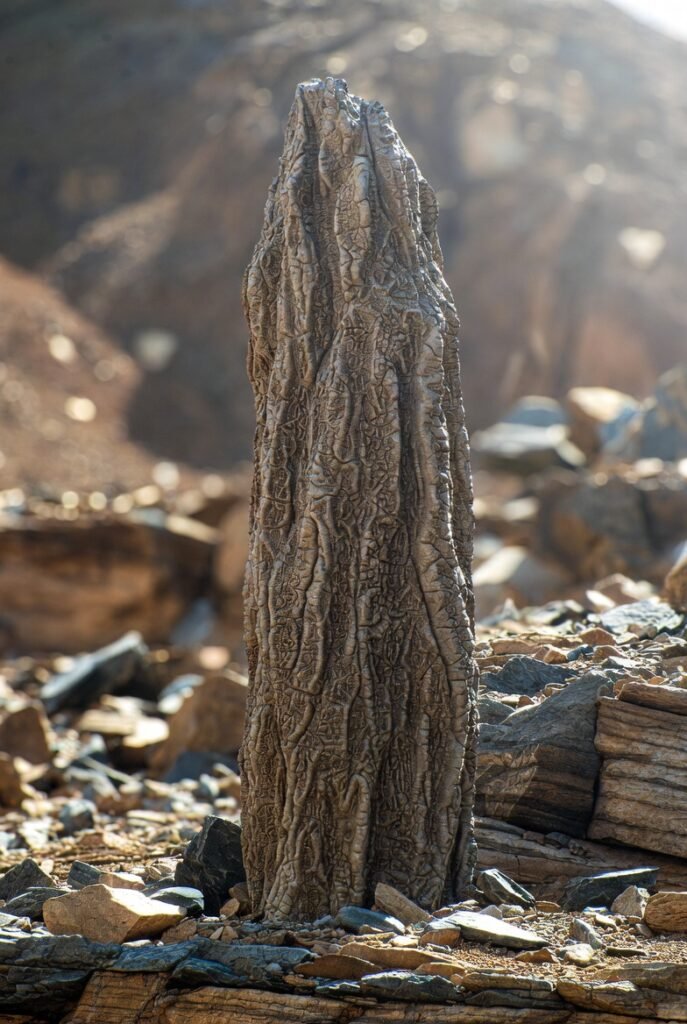
What Is the Prototaxites Fossil?
The Prototaxites fossil refers to the fossilized remains of an enigmatic organism that once dominated some of Earth’s earliest terrestrial ecosystems. First discovered more than 165 years ago, these fossils are massive, branchless structures that could reach up to eight meters (26 feet) in height.
Found in sedimentary rocks dating back around 400 million years, these structures have puzzled scientists for generations because they don’t fit neatly into known categories like plant, fungus, or algae.
A Scientific Mystery That Spans Centuries
The history of the Prototaxites fossil is nearly as fascinating as the organism itself:
- In the 1850s, the Canadian geologist John William Dawson first interpreted Prototaxites as a kind of primitive tree.
- Later, researchers suggested it could be a giant fungus based on similarities to fungal structures.
- More recent studies, however, challenge that classification, arguing there’s insufficient evidence to confidently group Prototaxites with any known life form.
This ongoing debate highlights just how unusual the organism really is and why it might represent a branch of life that’s entirely separate from anything alive today.
The Latest Research: A New Branch of Life?
In a study using microscopic anatomy and chemical analysis, researchers discovered that the organism’s features don’t match those of fungi, plants, algae, or even combinations like lichens.
According to the researchers:
- The anatomy and structure of Prototaxites don’t align with known biological lineages.
- Its chemical composition differs from typical plants or algae.
- Even fungal classification, once the leading hypothesis, doesn’t hold up under detailed scrutiny.
Because of this, some scientists now propose that the Prototaxites fossil represents a previously undescribed group of eukaryotes organisms with complex cells distinct from any living group today.
This doesn’t just make Prototaxites a scientific curiosity; it could fundamentally change how we think about life’s early diversity on land.
Why Prototaxites Matters
Understanding the Prototaxites fossil isn’t just about solving a 19th‑century mystery. It has broader implications:
A Window Into Ancient Ecosystems
During the late Silurian period around 400 million years ago landscapes looked dramatically different:
- Primitive plants, like early horsetails and ferns, barely reached knee height.
- Meanwhile, Prototaxites towered above them, possibly dominating environments we’re only beginning to understand.
This raises questions about nutrient cycles, ecosystem structures, and the evolution of early terrestrial life.
Challenges to the Tree of Life
The discovery shakes up conventional evolutionary classification. If Prototaxites truly belonged to a separate branch of life, we may need to reconsider assumptions about early eukaryotic evolution and the diversity of life forms that existed long before trees or vertebrates.
What Still Isn’t Known
Despite recent progress, many questions remain. For instance:
- What exactly did Prototaxites eat or absorb to grow so tall?
- How did it reproduce?
- Did it interact with other organisms in ways we haven’t yet uncovered?
Further research may reveal more details about this ancient giant.
Helpful Resources
- Learn more about the Silurian period from the University of California Museum of Paleontology: https://ucmp.berkeley.edu
- Read broadly about evolutionary classification and the tree of life at the Smithsonian National Museum of Natural History: https://naturalhistory.si.edu
Conclusion
The Prototaxites fossil stands as a compelling testament to Earth’s rich and often mysterious biological history. Far from being a mere footnote in paleontological archives, this giant organism challenges our understanding of how life diversified on land. Whether Prototaxites represents an entirely new branch of life or an unusually structured known organism, its study pushes science forward, reminding us that evolution often defies our expectations.
What to Read Next


3 Comments